Back to Blog
CRM
Engineering
January 20, 2025
8 min read
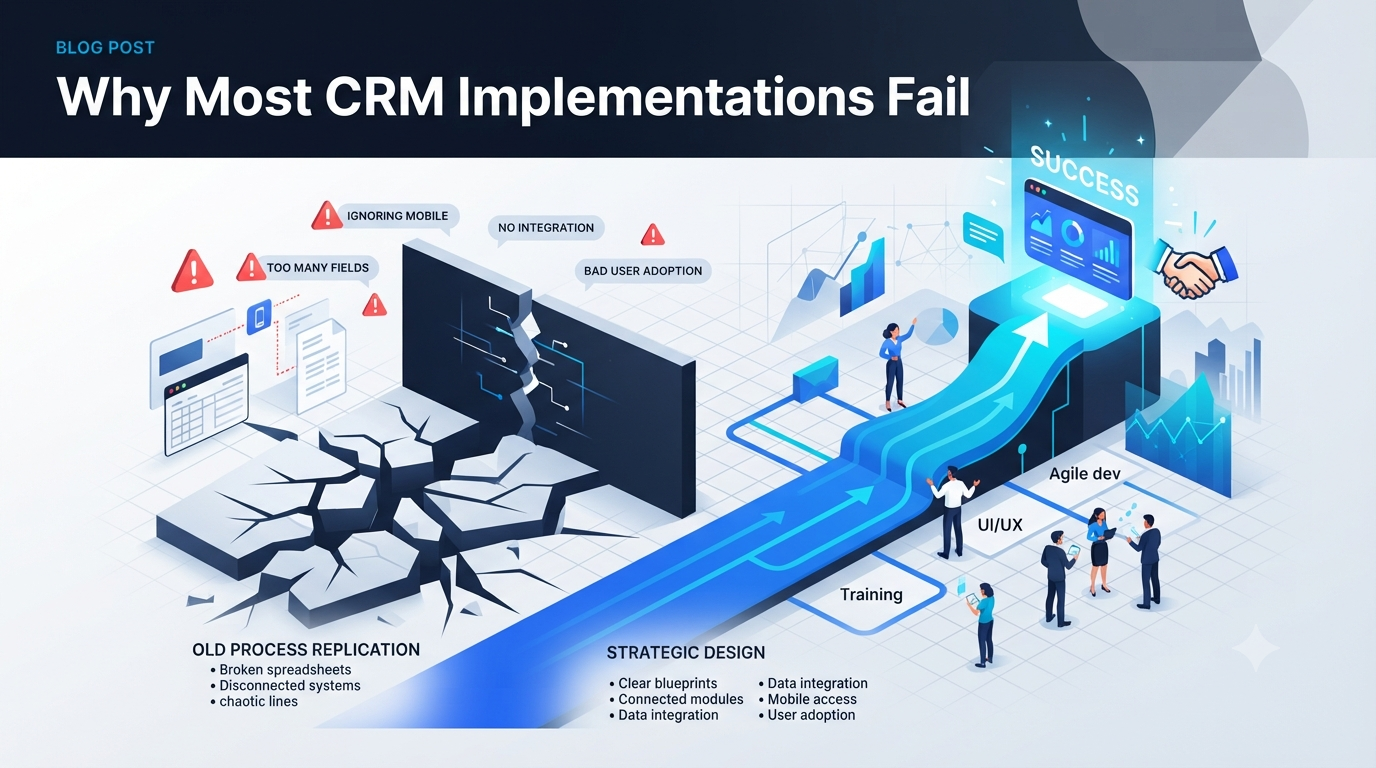
After building 15+ CRM systems for businesses across real estate, healthcare, education, and finance, I've seen a clear pattern. Most CRM implementations don't fail because of bad technology — they fail because of bad process.
Here are the 5 critical mistakes I've seen repeatedly, and the framework we use at HZX Labs to avoid them entirely.
The most common mistake is trying to digitize your existing broken process. If your spreadsheets are messy, your CRM will be too — just more expensive.
"Don't pave a cow path. Redesign the process first, then build the system around the new process."
Before writing a single line of code, we map out the ideal workflow. What should happen when a lead comes in? Who does what? What decisions need to be made? Only then do we configure the CRM to support that flow.
Everyone wants to track everything. The result? A form with 40 fields that no one fills out properly. Start with the essentials:
That's it for phase one. You can always add more fields as your team matures and actually needs them.
A CRM is only as good as the data in it. If your sales team doesn't use it consistently, you've wasted your money. We've found three things that drive adoption:
In Pakistan and across emerging markets, your sales team lives on their phone. If your CRM doesn't have a great mobile experience, adoption will tank. We build every CRM mobile-first.
Your CRM doesn't exist in a vacuum. It needs to connect with WhatsApp, email, accounting software, and any other tools your team uses. Siloed data is useless data.
We follow a 4-phase approach that has a 95% success rate across our CRM projects:
The key difference? We don't start building until the process is right. And we don't stop optimizing after launch.
If you're planning a CRM implementation and want to avoid these mistakes, let's talk. We offer a free 30-minute consultation where we'll audit your current process and give you honest feedback.